Example: Plaque psoriasis HTA report
Source:vignettes/example_hta_psoriasis.Rmd
example_hta_psoriasis.Rmd
library(multinma)
options(mc.cores = parallel::detectCores())
#> For execution on a local, multicore CPU with excess RAM we recommend calling
#> options(mc.cores = parallel::detectCores())
#>
#> Attaching package: 'multinma'
#> The following objects are masked from 'package:stats':
#>
#> dgamma, pgamma, qgammaThis vignette describes the analysis of treatments for
moderate-to-severe plaque psoriasis from an HTA report (Woolacott et al.
2006), replicating the analysis in NICE Technical Support
Document 2 (Dias et al.
2011). The data are available in this package as
hta_psoriasis:
head(hta_psoriasis)
#>   studyn   studyc year trtn             trtc sample_size PASI50 PASI75 PASI90
#> 1      1  Elewski 2004    1  Supportive care         193     12      5      1
#> 2      1  Elewski 2004    2 Etanercept 25 mg         196     59     46     21
#> 3      1  Elewski 2004    3 Etanercept 50 mg         194     54     56     40
#> 4      2 Gottlieb 2003    1  Supportive care          55      5      1      0
#> 5      2 Gottlieb 2003    2 Etanercept 25 mg          57     23     11      6
#> 6      3  Lebwohl 2003    1  Supportive care         122     13      5      1
Outcomes are ordered multinomial success/failure to achieve 50%, 75%, or 90% reduction in symptoms on the Psoriasis Area and Severity Index (PASI) scale. Some studies report ordered outcomes at all three cutpoints, others only one or two:
dplyr::filter(hta_psoriasis, studyc %in% c("Elewski", "Gordon", "ACD2058g", "Altmeyer"))
#>   studyn   studyc year trtn             trtc sample_size PASI50 PASI75 PASI90
#> 1      1  Elewski 2004    1  Supportive care         193     12      5      1
#> 2      1  Elewski 2004    2 Etanercept 25 mg         196     59     46     21
#> 3      1  Elewski 2004    3 Etanercept 50 mg         194     54     56     40
#> 4      5   Gordon 2003    1  Supportive care         187     18      8     NA
#> 5      5   Gordon 2003    4       Efalizumab         369    118     98     NA
#> 6      6 ACD2058g 2004    1  Supportive care         170     25     NA     NA
#> 7      6 ACD2058g 2004    4       Efalizumab         162     99     NA     NA
#> 8     10 Altmeyer 1994    1  Supportive care          51     NA      1     NA
#> 9     10 Altmeyer 1994    6         Fumaderm          49     NA     12     NA
Here, the outcome counts are given as “exclusive” counts. That is, for a study reporting all outcomes (e.g. Elewski), the counts represent the categories 50 < PASI < 75, 75 < PASI < 90, and 90 < PASI < 100, and the corresponding columns are named by the lower end of the interval. Missing values are used where studies only report a subset of the outcomes. For a study reporting only two outcomes, say PASI50 and PASI75 as in Gordon, the counts represent the categories 50 < PASI < 75 and 75 < PASI < 100. For a study reporting only one outcome, say PASI70 as in Altmeyer, the count represents 70 < PASI < 100. We also need the count for the lowest category (i.e. no higher outcomes achieved), which is equal to the sample size minus the counts in the other observed categories.
Setting up the network
We begin by setting up the network. We have arm-level ordered
multinomial count data, so we use the function
set_agd_arm(). The function multi() helps us
to specify the ordered outcomes correctly.
pso_net <- set_agd_arm(hta_psoriasis,
                       study = paste(studyc, year),
                       trt = trtc,
                       r = multi(r0 = sample_size - rowSums(cbind(PASI50, PASI75, PASI90), na.rm = TRUE),
                                 PASI50, PASI75, PASI90,
                                 inclusive = FALSE,
                                 type = "ordered"))
pso_net
#> A network with 16 AgD studies (arm-based).
#>
#> ------------------------------------------------------- AgD studies (arm-based) ----
#>  Study         Treatment arms
#>  ACD2058g 2004 2: Supportive care | Efalizumab
#>  ACD2600g 2004 2: Supportive care | Efalizumab
#>  Altmeyer 1994 2: Supportive care | Fumaderm
#>  Chaudari 2001 2: Supportive care | Infliximab
#>  Elewski 2004  3: Supportive care | Etanercept 25 mg | Etanercept 50 mg
#>  Ellis 1991    3: Supportive care | Ciclosporin | Ciclosporin
#>  Gordon 2003   2: Supportive care | Efalizumab
#>  Gottlieb 2003 2: Supportive care | Etanercept 25 mg
#>  Gottlieb 2004 3: Supportive care | Infliximab | Infliximab
#>  Guenther 1991 2: Supportive care | Ciclosporin
#>  ... plus 6 more studies
#>
#>  Outcome type: ordered (4 categories)
#> ------------------------------------------------------------------------------------
#> Total number of treatments: 8
#> Total number of studies: 16
#> Reference treatment is: Supportive care
#> Network is connected
Plot the network structure.
plot(pso_net, weight_edges = TRUE, weight_nodes = TRUE) +
  # Nudge the legend over
  ggplot2::theme(legend.box.spacing = ggplot2::unit(0.75, "in"),
                 plot.margin = ggplot2::margin(0.1, 0, 0.1, 0.75, "in"))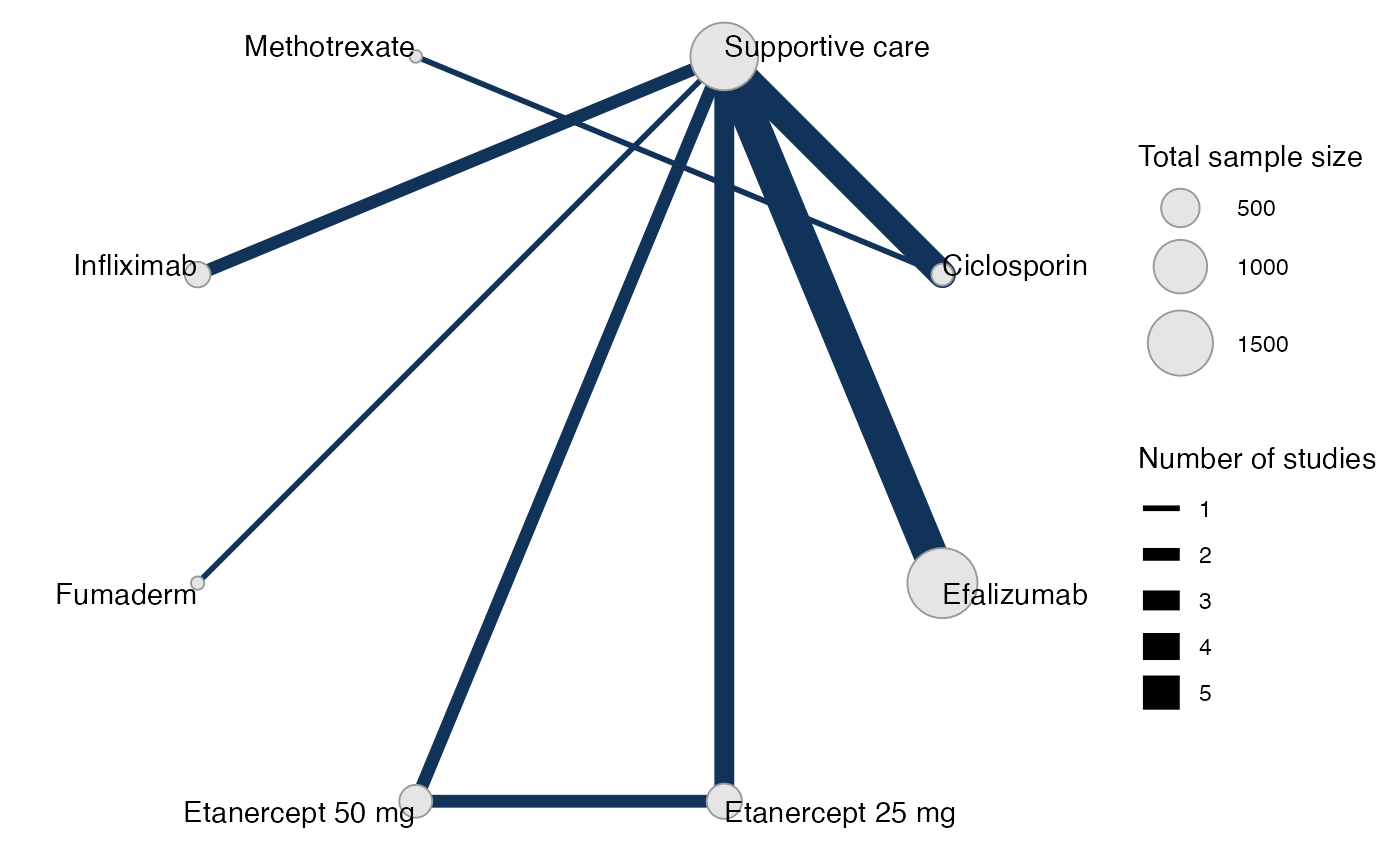
Meta-analysis models
We fit both fixed effect (FE) and random effects (RE) models.
Fixed effect meta-analysis
First, we fit a fixed effect model using the nma()
function with trt_effects = "fixed", using a probit link
function link = "probit". We use \mathrm{N}(0, 10^2) prior distributions for
the treatment effects d_k, and \mathrm{N}(0, 100^2) prior distributions for
the study-specific intercepts \mu_j. We
can examine the range of parameter values implied by these prior
distributions with the summary() method:
summary(normal(scale = 10))
#> A Normal prior distribution: location = 0, scale = 10.
#> 50% of the prior density lies between -6.74 and 6.74.
#> 95% of the prior density lies between -19.6 and 19.6.
summary(normal(scale = 100))
#> A Normal prior distribution: location = 0, scale = 100.
#> 50% of the prior density lies between -67.45 and 67.45.
#> 95% of the prior density lies between -196 and 196.
We also need to specify prior distributions for the latent cutpoints
c_\textrm{PASI75} and c_\textrm{PASI90} on the underlying scale -
here the PASI standardised mean difference due to the probit link (the
cutpoint c_\textrm{PASI50}=0). To make
these easier to reason about, we actually specify priors on the
differences between adjacent cutpoints, e.g. c_\textrm{PASI90} - c_\textrm{PASI75} and
c_\textrm{PASI75} - c_\textrm{PASI50}.
These can be given any positive-valued prior distribution, and Stan will
automatically impose the necessary ordering constraints behind the
scenes. We choose to give these implicit flat priors
flat().
The model is fitted using the nma() function.
pso_fit_FE <- nma(pso_net,
                  trt_effects = "fixed",
                  link = "probit",
                  prior_intercept = normal(scale = 100),
                  prior_trt = normal(scale = 10),
                  prior_aux = flat())
#> Note: Setting "Supportive care" as the network reference treatment.
Basic parameter summaries are given by the print()
method:
pso_fit_FE
#> A fixed effects NMA with a ordered likelihood (probit link).
#> Inference for Stan model: ordered_multinomial.
#> 4 chains, each with iter=2000; warmup=1000; thin=1;
#> post-warmup draws per chain=1000, total post-warmup draws=4000.
#>
#>                         mean se_mean   sd     2.5%      25%      50%      75%    97.5% n_eff
#> d[Ciclosporin]          1.92    0.01 0.33     1.31     1.68     1.91     2.14     2.61  1525
#> d[Efalizumab]           1.19    0.00 0.06     1.07     1.15     1.19     1.23     1.30  1886
#> d[Etanercept 25 mg]     1.51    0.00 0.10     1.32     1.45     1.51     1.58     1.70  2002
#> d[Etanercept 50 mg]     1.92    0.00 0.10     1.72     1.85     1.92     1.99     2.11  2100
#> d[Fumaderm]             1.48    0.01 0.48     0.63     1.14     1.44     1.78     2.49  2793
#> d[Infliximab]           2.33    0.01 0.27     1.84     2.14     2.32     2.50     2.88  2568
#> d[Methotrexate]         1.62    0.01 0.44     0.77     1.33     1.61     1.91     2.49  1833
#> lp__                -3405.05    0.09 3.52 -3412.77 -3407.19 -3404.72 -3402.54 -3399.05  1610
#> cc[PASI50]              0.00     NaN 0.00     0.00     0.00     0.00     0.00     0.00   NaN
#> cc[PASI75]              0.76    0.00 0.03     0.70     0.74     0.76     0.78     0.82  5083
#> cc[PASI90]              1.56    0.00 0.05     1.46     1.53     1.56     1.60     1.67  5920
#>                     Rhat
#> d[Ciclosporin]         1
#> d[Efalizumab]          1
#> d[Etanercept 25 mg]    1
#> d[Etanercept 50 mg]    1
#> d[Fumaderm]            1
#> d[Infliximab]          1
#> d[Methotrexate]        1
#> lp__                   1
#> cc[PASI50]           NaN
#> cc[PASI75]             1
#> cc[PASI90]             1
#>
#> Samples were drawn using NUTS(diag_e) at Fri Oct  9 11:36:29 2026.
#> For each parameter, n_eff is a crude measure of effective sample size,
#> and Rhat is the potential scale reduction factor on split chains (at
#> convergence, Rhat=1).
Note: the treatment effects are the opposite sign to those in TSD 2 (Dias et al. 2011). This is because we parameterise the linear predictor as \mu_j + d_k + c_m, rather than \mu_j + d_k - c_m. The interpretation here thus follows that of a standard binomial probit (or logit) regression; SMDs (or log ORs) greater than zero mean that the treatment increases the probability of an event compared to the comparator (and less than zero mean a reduction in probability). Here higher outcomes are positive, and all of the active treatments are estimated to increase the response (i.e. a greater reduction) on the PASI scale compared to the network reference (supportive care).
By default, summaries of the study-specific intercepts \mu_j are hidden, but could be examined by
changing the pars argument:
The prior and posterior distributions can be compared visually using
the plot_prior_posterior() function:
plot_prior_posterior(pso_fit_FE)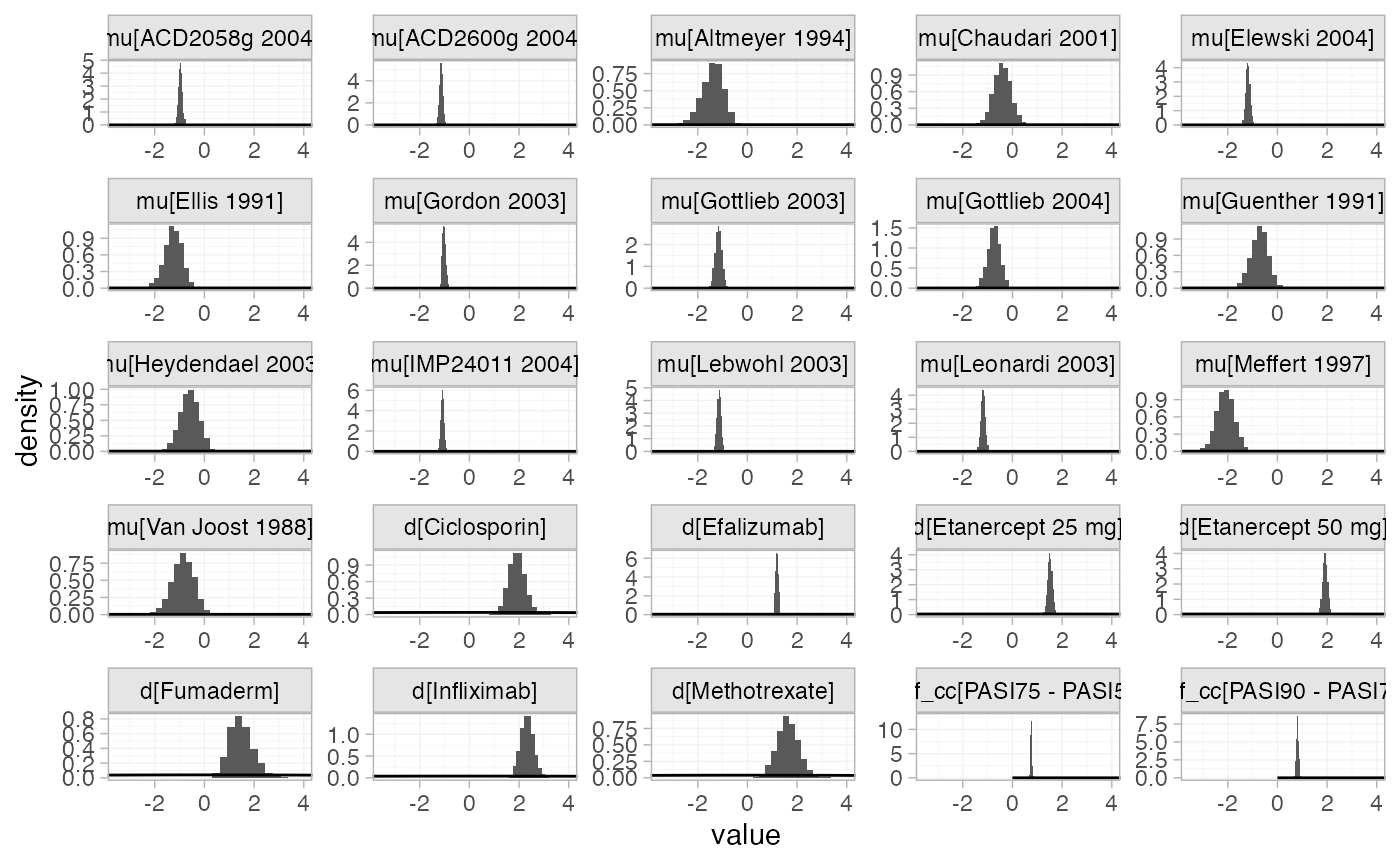
Focusing specifically on the cutpoints we see that these are highly identified by the data, which is why the implicit flat priors work for these parameters.
plot_prior_posterior(pso_fit_FE, prior = "aux")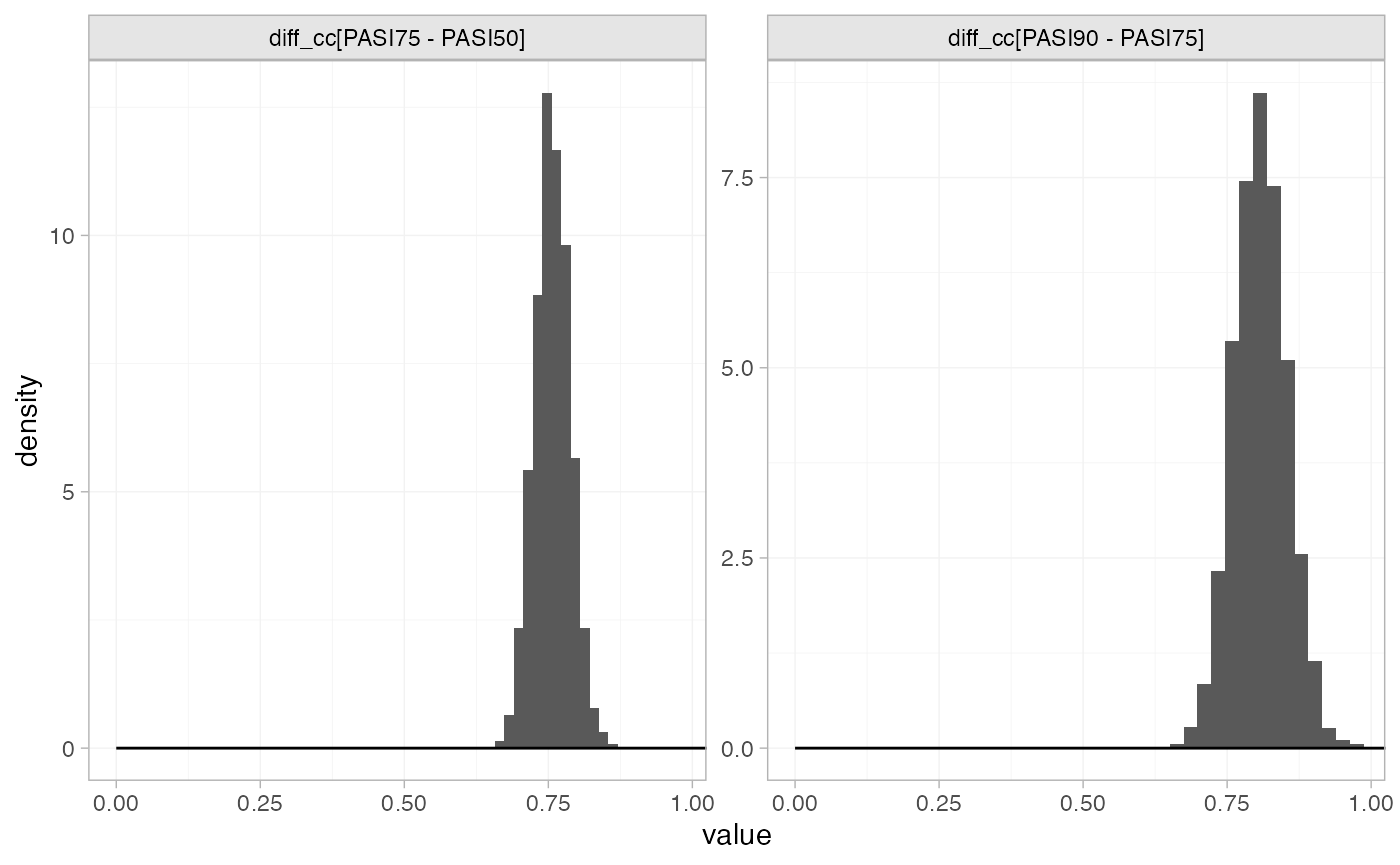
Random effects meta-analysis
We now fit a random effects model using the nma()
function with trt_effects = "random". Again, we use \mathrm{N}(0, 10^2) prior distributions for
the treatment effects d_k, \mathrm{N}(0, 100^2) prior distributions for
the study-specific intercepts \mu_j,
implicit flat prior distributions for the latent cutpoints, and we
additionally use a \textrm{half-N}(2.5^2) prior for the
heterogeneity standard deviation \tau.
We can examine the range of parameter values implied by these prior
distributions with the summary() method:
summary(normal(scale = 10))
#> A Normal prior distribution: location = 0, scale = 10.
#> 50% of the prior density lies between -6.74 and 6.74.
#> 95% of the prior density lies between -19.6 and 19.6.
summary(normal(scale = 100))
#> A Normal prior distribution: location = 0, scale = 100.
#> 50% of the prior density lies between -67.45 and 67.45.
#> 95% of the prior density lies between -196 and 196.
summary(half_normal(scale = 2.5))
#> A half-Normal prior distribution: scale = 2.5.
#> 50% of the prior density lies between 0 and 1.69.
#> 95% of the prior density lies between 0 and 4.9.
Fitting the RE model
pso_fit_RE <- nma(pso_net,
                  trt_effects = "random",
                  link = "probit",
                  prior_intercept = normal(scale = 100),
                  prior_trt = normal(scale = 10),
                  prior_aux = flat(),
                  prior_het = half_normal(scale = 2.5),
                  adapt_delta = 0.99)
#> Note: Setting "Supportive care" as the network reference treatment.Basic parameter summaries are given by the print()
method:
pso_fit_RE
#> A random effects NMA with a ordered likelihood (probit link).
#> Inference for Stan model: ordered_multinomial.
#> 4 chains, each with iter=5000; warmup=2500; thin=1;
#> post-warmup draws per chain=2500, total post-warmup draws=10000.
#>
#>                         mean se_mean   sd     2.5%      25%      50%      75%    97.5% n_eff
#> d[Ciclosporin]          2.03    0.01 0.43     1.28     1.73     2.00     2.28     3.00  2632
#> d[Efalizumab]           1.19    0.00 0.17     0.83     1.11     1.19     1.27     1.55  5167
#> d[Etanercept 25 mg]     1.53    0.00 0.24     1.04     1.40     1.52     1.64     2.04  5563
#> d[Etanercept 50 mg]     1.93    0.00 0.27     1.39     1.79     1.92     2.06     2.48  5322
#> d[Fumaderm]             1.49    0.01 0.61     0.34     1.10     1.47     1.86     2.76  7432
#> d[Infliximab]           2.32    0.00 0.38     1.55     2.09     2.31     2.55     3.09  6627
#> d[Methotrexate]         1.72    0.01 0.63     0.59     1.31     1.68     2.08     3.07  3572
#> lp__                -3410.71    0.18 6.65 -3424.30 -3415.13 -3410.50 -3405.98 -3398.57  1323
#> tau                     0.30    0.01 0.22     0.02     0.15     0.27     0.42     0.84   888
#> cc[PASI50]              0.00     NaN 0.00     0.00     0.00     0.00     0.00     0.00   NaN
#> cc[PASI75]              0.76    0.00 0.03     0.70     0.74     0.76     0.78     0.82 13830
#> cc[PASI90]              1.56    0.00 0.05     1.46     1.53     1.56     1.60     1.67 15982
#>                     Rhat
#> d[Ciclosporin]         1
#> d[Efalizumab]          1
#> d[Etanercept 25 mg]    1
#> d[Etanercept 50 mg]    1
#> d[Fumaderm]            1
#> d[Infliximab]          1
#> d[Methotrexate]        1
#> lp__                   1
#> tau                    1
#> cc[PASI50]           NaN
#> cc[PASI75]             1
#> cc[PASI90]             1
#>
#> Samples were drawn using NUTS(diag_e) at Fri Oct  9 11:37:24 2026.
#> For each parameter, n_eff is a crude measure of effective sample size,
#> and Rhat is the potential scale reduction factor on split chains (at
#> convergence, Rhat=1).
By default, summaries of the study-specific intercepts \mu_j and study-specific relative effects
\delta_{jk} are hidden, but could be
examined by changing the pars argument:
The prior and posterior distributions can be compared visually using
the plot_prior_posterior() function:
plot_prior_posterior(pso_fit_RE, prior = c("trt", "aux", "het"))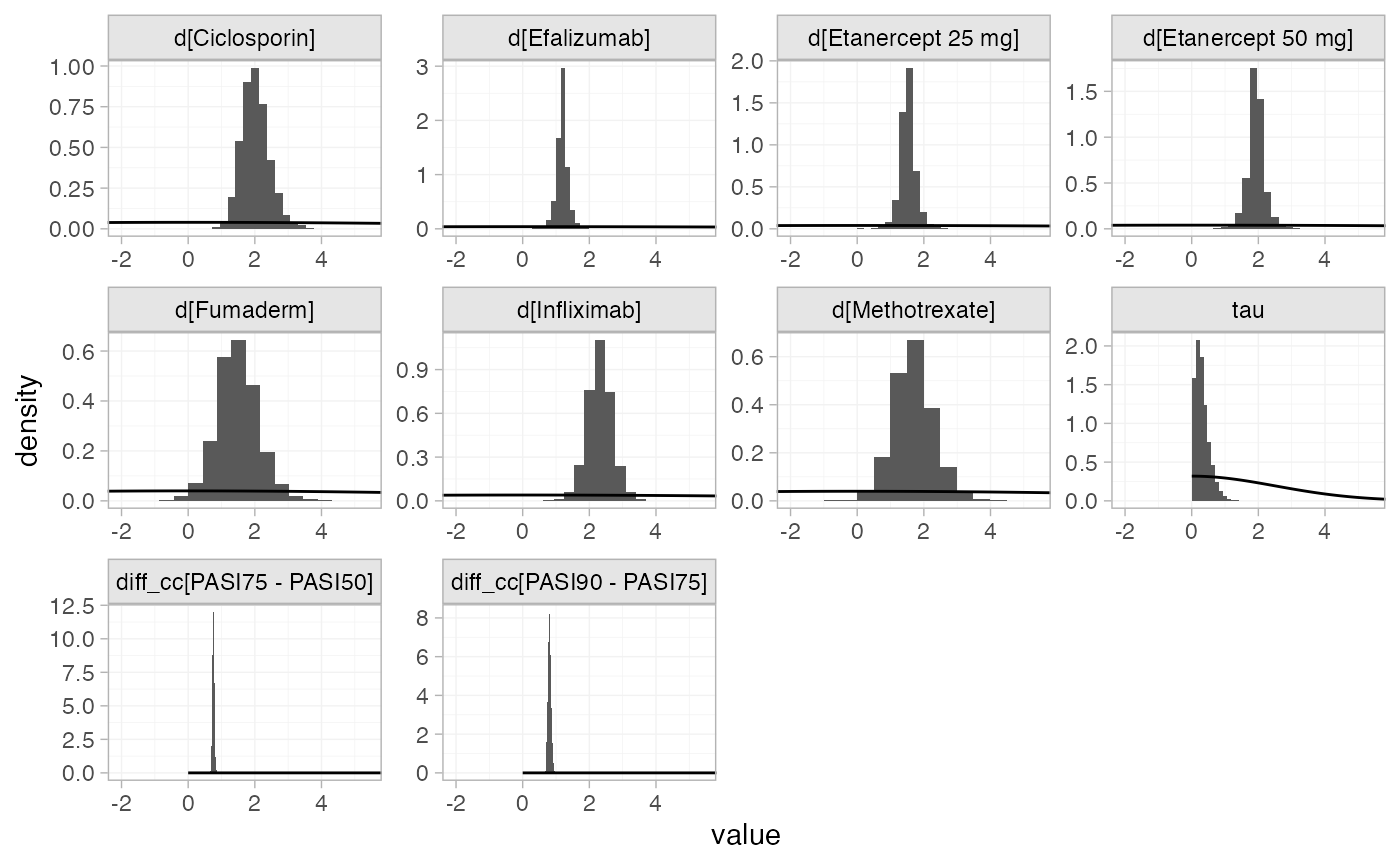
Model comparison
Model fit can be checked using the dic() function:
(dic_FE <- dic(pso_fit_FE))
#> Residual deviance: 74.7 (on 58 data points)
#>                pD: 25.2
#>               DIC: 100
(dic_RE <- dic(pso_fit_RE))
#> Residual deviance: 63 (on 58 data points)
#>                pD: 33.3
#>               DIC: 96.3
The random effects model has a lower DIC and the residual deviance is closer to the number of data points, so is preferred in this case.
We can also examine the residual deviance contributions with the
corresponding plot() method.
plot(dic_FE)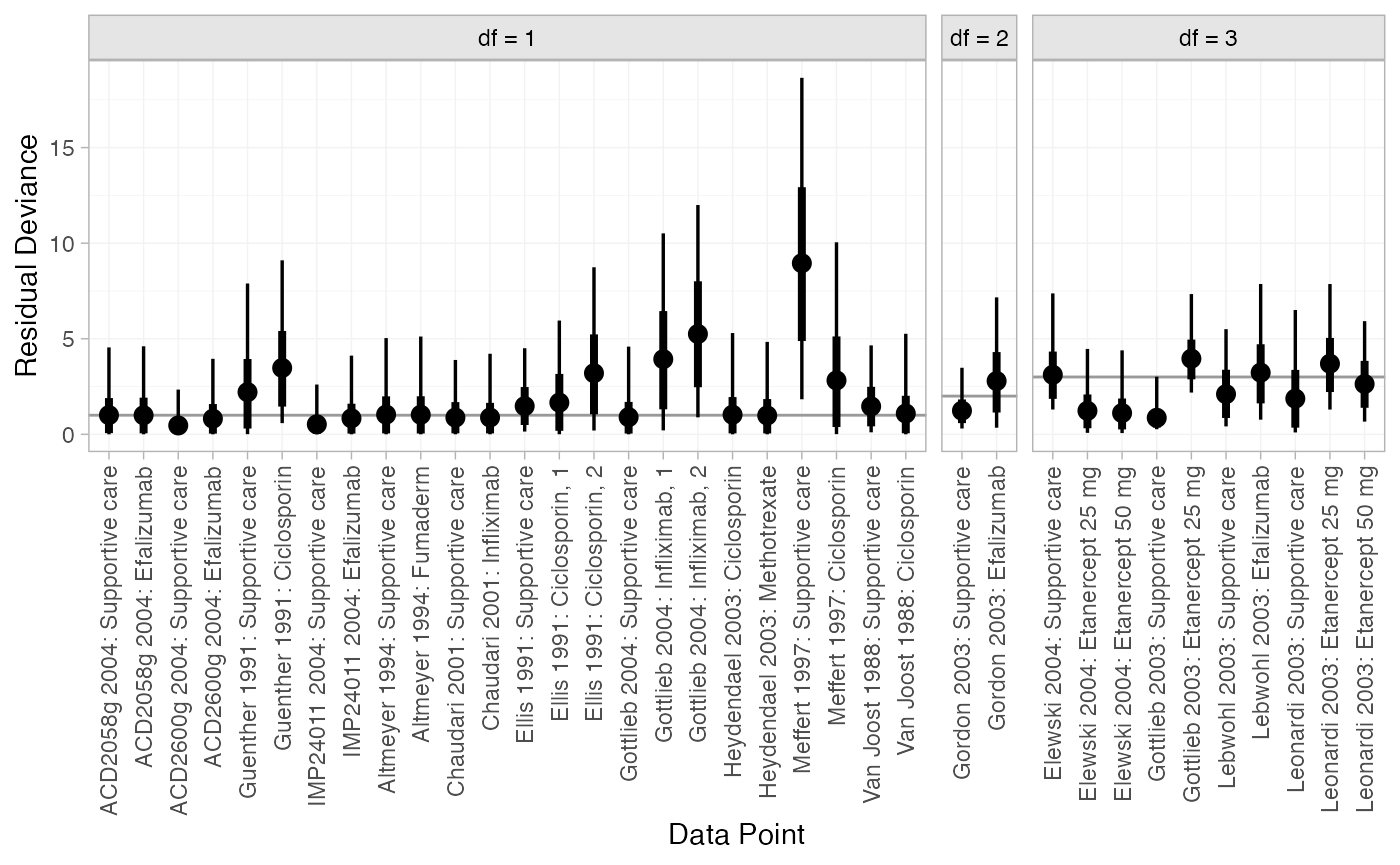
plot(dic_RE)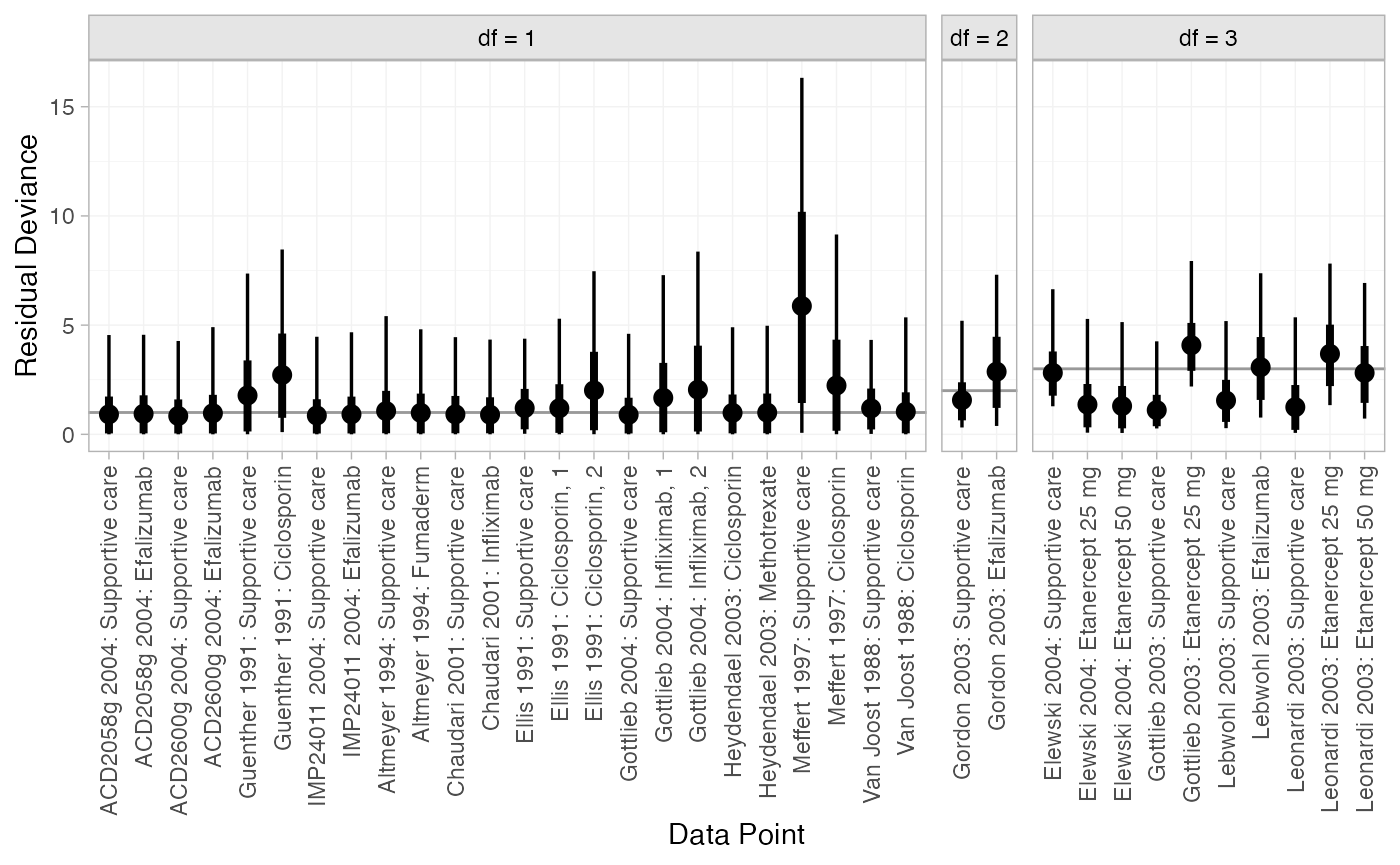
Most data points are fit well, with posterior mean residual deviances close to the degrees of freedom. The Meffert 1997 study has a substantially higher residual deviance contribution, which could be investigated further to see why this study appears to be an outlier.
Further results
Predicted probabilities of response
Dias et al. (2011) produce absolute predictions of
probability of achieving responses at each PASI cutoff, assuming a
Normal distribution for the baseline probit probability of PASI50
response on supportive care with mean -1.097 and precision 123. We can replicate these results using the
predict() method. The baseline argument takes
a distr() distribution object, with which we specify the
corresponding Normal distribution. We set type = "response"
to produce predicted probabilities (type = "link" would
produce predicted probit probabilities).
pred_FE <- predict(pso_fit_FE,
                   baseline = distr(qnorm, mean = -1.097, sd = 123^-0.5),
                   type = "response")
pred_FE
#>                                mean   sd 2.5%  25%  50%  75% 97.5% Bulk_ESS Tail_ESS Rhat
#> pred[Supportive care, PASI50]  0.14 0.02 0.10 0.12 0.14 0.15  0.18     3631     3432    1
#> pred[Supportive care, PASI75]  0.03 0.01 0.02 0.03 0.03 0.04  0.05     3724     3434    1
#> pred[Supportive care, PASI90]  0.00 0.00 0.00 0.00 0.00 0.00  0.01     4040     3841    1
#> pred[Ciclosporin, PASI50]      0.78 0.10 0.57 0.72 0.79 0.85  0.94     1633     2194    1
#> pred[Ciclosporin, PASI75]      0.52 0.13 0.28 0.43 0.52 0.61  0.78     1616     2120    1
#> pred[Ciclosporin, PASI90]      0.24 0.11 0.08 0.16 0.23 0.30  0.49     1646     2169    1
#> pred[Efalizumab, PASI50]       0.54 0.04 0.45 0.51 0.54 0.57  0.62     2866     3591    1
#> pred[Efalizumab, PASI75]       0.25 0.03 0.19 0.23 0.25 0.28  0.33     2948     3178    1
#> pred[Efalizumab, PASI90]       0.07 0.02 0.05 0.06 0.07 0.08  0.11     3189     3694    1
#> pred[Etanercept 25 mg, PASI50] 0.66 0.05 0.56 0.63 0.66 0.69  0.75     2515     3271    1
#> pred[Etanercept 25 mg, PASI75] 0.37 0.05 0.27 0.33 0.37 0.40  0.47     2600     3535    1
#> pred[Etanercept 25 mg, PASI90] 0.13 0.03 0.08 0.11 0.12 0.14  0.19     2802     3523    1
#> pred[Etanercept 50 mg, PASI50] 0.79 0.04 0.71 0.77 0.79 0.82  0.86     2596     3315    1
#> pred[Etanercept 50 mg, PASI75] 0.53 0.05 0.42 0.49 0.53 0.56  0.63     2689     3381    1
#> pred[Etanercept 50 mg, PASI90] 0.23 0.04 0.16 0.20 0.23 0.26  0.32     2813     3509    1
#> pred[Fumaderm, PASI50]         0.63 0.16 0.32 0.51 0.63 0.76  0.92     3142     2210    1
#> pred[Fumaderm, PASI75]         0.37 0.17 0.11 0.23 0.34 0.47  0.75     3086     2160    1
#> pred[Fumaderm, PASI90]         0.14 0.11 0.02 0.06 0.11 0.19  0.44     3055     2146    1
#> pred[Infliximab, PASI50]       0.88 0.05 0.76 0.85 0.89 0.92  0.97     2858     2694    1
#> pred[Infliximab, PASI75]       0.68 0.10 0.47 0.61 0.68 0.74  0.86     2832     2656    1
#> pred[Infliximab, PASI90]       0.37 0.10 0.19 0.30 0.37 0.44  0.60     2893     2673    1
#> pred[Methotrexate, PASI50]     0.68 0.14 0.37 0.59 0.70 0.79  0.92     1917     2382    1
#> pred[Methotrexate, PASI75]     0.42 0.16 0.14 0.30 0.41 0.52  0.74     1893     2389    1
#> pred[Methotrexate, PASI90]     0.17 0.11 0.03 0.09 0.15 0.23  0.43     1923     2344    1
plot(pred_FE)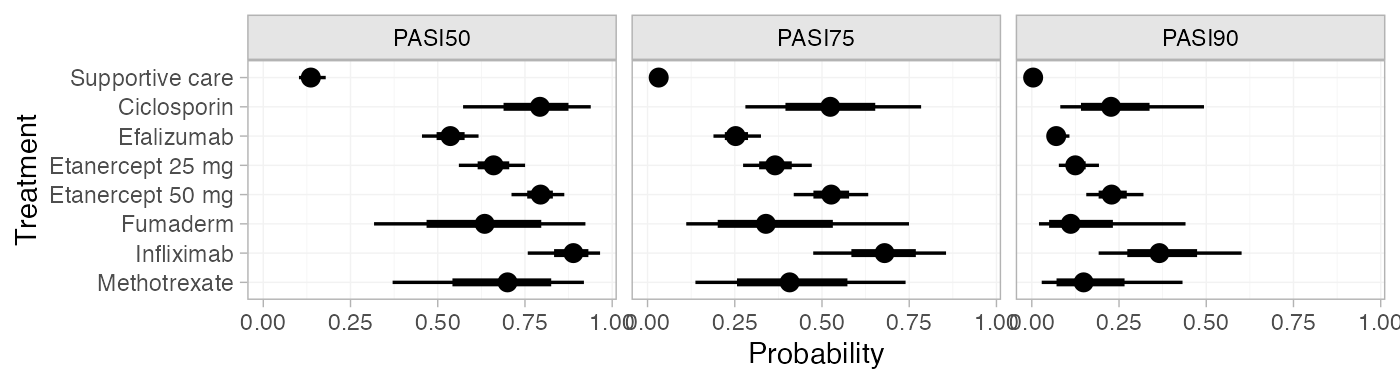
pred_RE <- predict(pso_fit_RE,
                   baseline = distr(qnorm, mean = -1.097, sd = 123^-0.5),
                   type = "response")
pred_RE
#>                                mean   sd 2.5%  25%  50%  75% 97.5% Bulk_ESS Tail_ESS Rhat
#> pred[Supportive care, PASI50]  0.14 0.02 0.10 0.12 0.14 0.15  0.18     9886     9993    1
#> pred[Supportive care, PASI75]  0.03 0.01 0.02 0.03 0.03 0.04  0.05    10163     9605    1
#> pred[Supportive care, PASI90]  0.00 0.00 0.00 0.00 0.00 0.00  0.01    10655     9770    1
#> pred[Ciclosporin, PASI50]      0.80 0.11 0.57 0.74 0.82 0.88  0.97     3163     2937    1
#> pred[Ciclosporin, PASI75]      0.56 0.15 0.28 0.45 0.56 0.67  0.88     3136     2942    1
#> pred[Ciclosporin, PASI90]      0.28 0.14 0.08 0.18 0.25 0.36  0.64     3144     2894    1
#> pred[Efalizumab, PASI50]       0.54 0.07 0.38 0.49 0.54 0.58  0.69     5757     4408    1
#> pred[Efalizumab, PASI75]       0.26 0.06 0.15 0.22 0.25 0.29  0.40     5778     4713    1
#> pred[Efalizumab, PASI90]       0.07 0.03 0.03 0.06 0.07 0.09  0.14     5900     4736    1
#> pred[Etanercept 25 mg, PASI50] 0.66 0.09 0.47 0.61 0.66 0.72  0.84     5966     4133    1
#> pred[Etanercept 25 mg, PASI75] 0.38 0.09 0.20 0.32 0.37 0.43  0.59     5995     4134    1
#> pred[Etanercept 25 mg, PASI90] 0.14 0.06 0.05 0.10 0.13 0.16  0.28     6074     4406    1
#> pred[Etanercept 50 mg, PASI50] 0.79 0.08 0.60 0.75 0.80 0.84  0.92     5972     4179    1
#> pred[Etanercept 50 mg, PASI75] 0.53 0.10 0.31 0.47 0.53 0.59  0.74     6014     4295    1
#> pred[Etanercept 50 mg, PASI90] 0.24 0.09 0.10 0.19 0.23 0.28  0.44     6038     4088    1
#> pred[Fumaderm, PASI50]         0.63 0.20 0.23 0.49 0.65 0.78  0.95     7760     5863    1
#> pred[Fumaderm, PASI75]         0.38 0.20 0.06 0.22 0.35 0.51  0.82     7766     5810    1
#> pred[Fumaderm, PASI90]         0.16 0.14 0.01 0.06 0.12 0.21  0.54     7769     6034    1
#> pred[Infliximab, PASI50]       0.87 0.08 0.67 0.84 0.89 0.93  0.98     6782     5359    1
#> pred[Infliximab, PASI75]       0.67 0.13 0.37 0.59 0.68 0.76  0.90     6699     5604    1
#> pred[Infliximab, PASI90]       0.37 0.14 0.13 0.28 0.37 0.46  0.68     6707     5153    1
#> pred[Methotrexate, PASI50]     0.70 0.18 0.30 0.58 0.72 0.84  0.98     4376     2952    1
#> pred[Methotrexate, PASI75]     0.45 0.21 0.10 0.29 0.43 0.59  0.89     4343     2992    1
#> pred[Methotrexate, PASI90]     0.21 0.17 0.02 0.09 0.16 0.28  0.66     4350     3046    1
plot(pred_RE)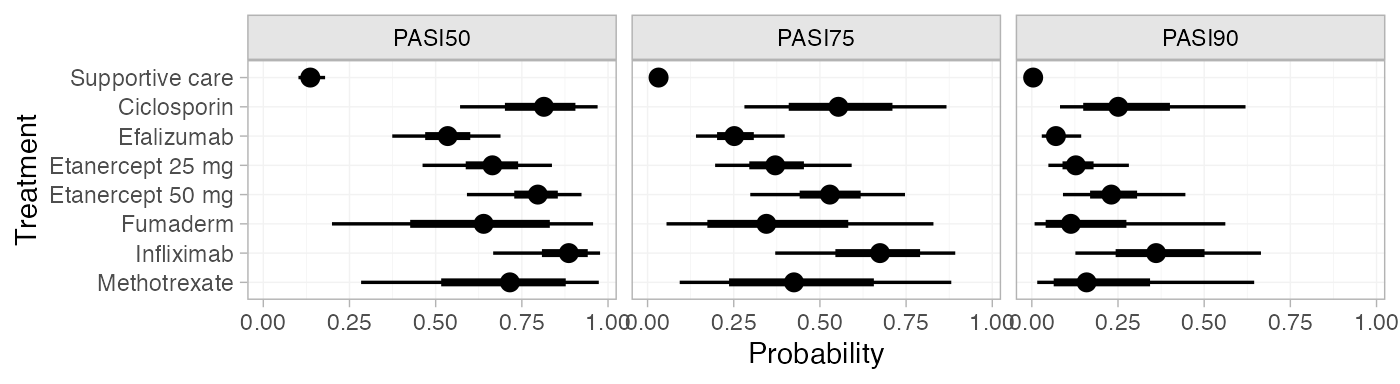
If instead of information on the baseline PASI 50 response probit
probability we have PASI 50 event counts, we can use these to construct
a Beta distribution for the baseline probability of PASI 50 response.
For example, if 56 out of 408 individuals achieved PASI 50 response on
supportive care in the target population of interest, the appropriate
Beta distribution for the response probability would be \textrm{Beta}(56, 408-56). We can specify
this Beta distribution for the baseline response using the
baseline_type = "reponse" argument (the default is
"link", used above for the baseline probit
probability).
pred_FE_beta <- predict(pso_fit_FE,
                        baseline = distr(qbeta, 56, 408-56),
                        baseline_type = "response",
                        type = "response")
pred_FE_beta
#>                                mean   sd 2.5%  25%  50%  75% 97.5% Bulk_ESS Tail_ESS Rhat
#> pred[Supportive care, PASI50]  0.14 0.02 0.10 0.12 0.14 0.15  0.17     3940     4002    1
#> pred[Supportive care, PASI75]  0.03 0.01 0.02 0.03 0.03 0.04  0.05     4026     3931    1
#> pred[Supportive care, PASI90]  0.00 0.00 0.00 0.00 0.00 0.00  0.01     4614     4140    1
#> pred[Ciclosporin, PASI50]      0.78 0.09 0.58 0.72 0.79 0.85  0.94     1659     2017    1
#> pred[Ciclosporin, PASI75]      0.52 0.13 0.29 0.43 0.52 0.61  0.78     1636     1987    1
#> pred[Ciclosporin, PASI90]      0.24 0.11 0.08 0.16 0.23 0.30  0.49     1669     2093    1
#> pred[Efalizumab, PASI50]       0.54 0.04 0.46 0.51 0.54 0.56  0.61     3238     3759    1
#> pred[Efalizumab, PASI75]       0.25 0.03 0.19 0.23 0.25 0.28  0.32     3276     3480    1
#> pred[Efalizumab, PASI90]       0.07 0.02 0.05 0.06 0.07 0.08  0.10     3624     3838    1
#> pred[Etanercept 25 mg, PASI50] 0.66 0.05 0.56 0.63 0.66 0.69  0.74     2528     3368    1
#> pred[Etanercept 25 mg, PASI75] 0.37 0.05 0.28 0.34 0.37 0.40  0.46     2682     3458    1
#> pred[Etanercept 25 mg, PASI90] 0.13 0.03 0.08 0.11 0.13 0.14  0.19     3045     3396    1
#> pred[Etanercept 50 mg, PASI50] 0.79 0.04 0.71 0.77 0.79 0.82  0.86     2616     3614    1
#> pred[Etanercept 50 mg, PASI75] 0.53 0.05 0.42 0.49 0.53 0.56  0.62     2735     3551    1
#> pred[Etanercept 50 mg, PASI90] 0.23 0.04 0.16 0.20 0.23 0.26  0.32     2852     3278    1
#> pred[Fumaderm, PASI50]         0.63 0.16 0.32 0.51 0.63 0.75  0.92     3227     2153    1
#> pred[Fumaderm, PASI75]         0.36 0.17 0.11 0.23 0.34 0.47  0.75     3191     2153    1
#> pred[Fumaderm, PASI90]         0.14 0.11 0.02 0.06 0.11 0.19  0.44     3162     2112    1
#> pred[Infliximab, PASI50]       0.88 0.05 0.76 0.85 0.89 0.92  0.96     2662     2669    1
#> pred[Infliximab, PASI75]       0.68 0.10 0.48 0.61 0.68 0.74  0.85     2649     2702    1
#> pred[Infliximab, PASI90]       0.37 0.10 0.19 0.30 0.37 0.44  0.59     2721     2621    1
#> pred[Methotrexate, PASI50]     0.68 0.14 0.37 0.59 0.70 0.79  0.92     1918     2206    1
#> pred[Methotrexate, PASI75]     0.42 0.16 0.13 0.30 0.41 0.52  0.74     1896     2275    1
#> pred[Methotrexate, PASI90]     0.17 0.11 0.03 0.09 0.15 0.23  0.43     1924     2318    1
plot(pred_FE_beta)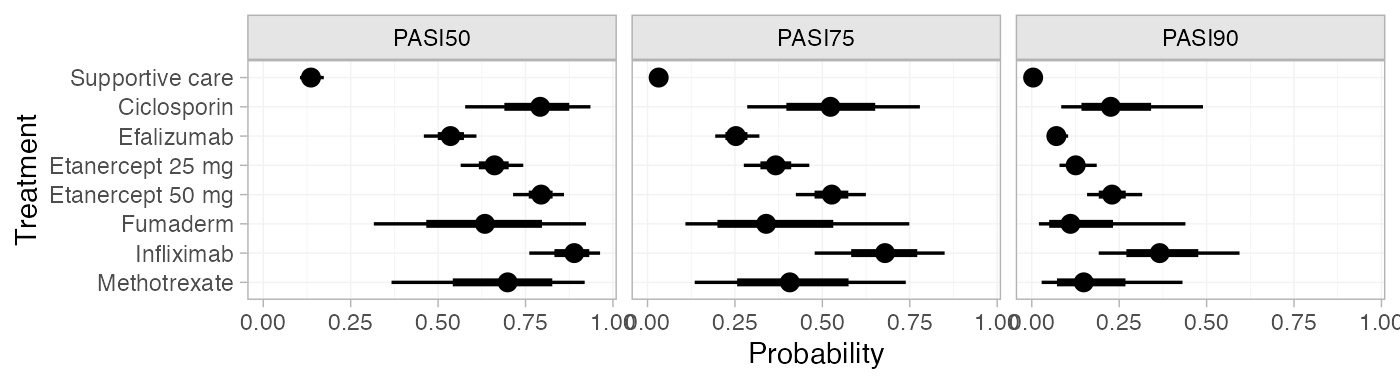
pred_RE_beta <- predict(pso_fit_RE,
baseline = distr(qbeta, 56, 408-56),
baseline_type = "response",
type = "response")
pred_RE_beta
#> mean sd 2.5% 25% 50% 75% 97.5% Bulk_ESS Tail_ESS Rhat
#> pred[Supportive care, PASI50] 0.14 0.02 0.11 0.13 0.14 0.15 0.17 9843 9606 1
#> pred[Supportive care, PASI75] 0.03 0.01 0.02 0.03 0.03 0.04 0.05 10487 9325 1
#> pred[Supportive care, PASI90] 0.00 0.00 0.00 0.00 0.00 0.00 0.01 11381 9952 1
#> pred[Ciclosporin, PASI50] 0.80 0.11 0.57 0.74 0.82 0.88 0.97 3223 3003 1
#> pred[Ciclosporin, PASI75] 0.56 0.15 0.28 0.45 0.56 0.67 0.88 3186 2949 1
#> pred[Ciclosporin, PASI90] 0.28 0.14 0.08 0.18 0.25 0.36 0.63 3197 2760 1
#> pred[Efalizumab, PASI50] 0.54 0.07 0.38 0.49 0.54 0.58 0.69 5757 4716 1
#> pred[Efalizumab, PASI75] 0.26 0.06 0.15 0.22 0.25 0.29 0.39 5802 4462 1
#> pred[Efalizumab, PASI90] 0.07 0.03 0.03 0.06 0.07 0.09 0.14 6010 4735 1
#> pred[Etanercept 25 mg, PASI50] 0.66 0.09 0.47 0.61 0.67 0.71 0.83 6044 3865 1
#> pred[Etanercept 25 mg, PASI75] 0.38 0.09 0.20 0.32 0.37 0.42 0.58 6103 4137 1
#> pred[Etanercept 25 mg, PASI90] 0.14 0.06 0.05 0.10 0.13 0.16 0.28 6197 3926 1
#> pred[Etanercept 50 mg, PASI50] 0.79 0.08 0.61 0.75 0.80 0.84 0.92 5924 4214 1
#> pred[Etanercept 50 mg, PASI75] 0.53 0.10 0.31 0.47 0.53 0.59 0.74 5979 4362 1
#> pred[Etanercept 50 mg, PASI90] 0.24 0.08 0.10 0.19 0.23 0.28 0.44 5999 4195 1
#> pred[Fumaderm, PASI50] 0.63 0.19 0.22 0.50 0.64 0.78 0.95 7794 6405 1
#> pred[Fumaderm, PASI75] 0.38 0.20 0.06 0.22 0.35 0.50 0.82 7802 6270 1
#> pred[Fumaderm, PASI90] 0.16 0.14 0.01 0.06 0.12 0.21 0.55 7804 6204 1
#> pred[Infliximab, PASI50] 0.87 0.08 0.67 0.84 0.89 0.93 0.98 6856 4835 1
#> pred[Infliximab, PASI75] 0.67 0.13 0.37 0.59 0.68 0.76 0.90 6750 4453 1
#> pred[Infliximab, PASI90] 0.37 0.14 0.13 0.28 0.36 0.46 0.68 6760 4115 1
#> pred[Methotrexate, PASI50] 0.70 0.18 0.30 0.58 0.72 0.84 0.98 4309 2935 1
#> pred[Methotrexate, PASI75] 0.45 0.21 0.10 0.29 0.43 0.59 0.89 4280 3033 1
#> pred[Methotrexate, PASI90] 0.21 0.17 0.02 0.09 0.16 0.28 0.66 4307 3171 1
plot(pred_RE_beta)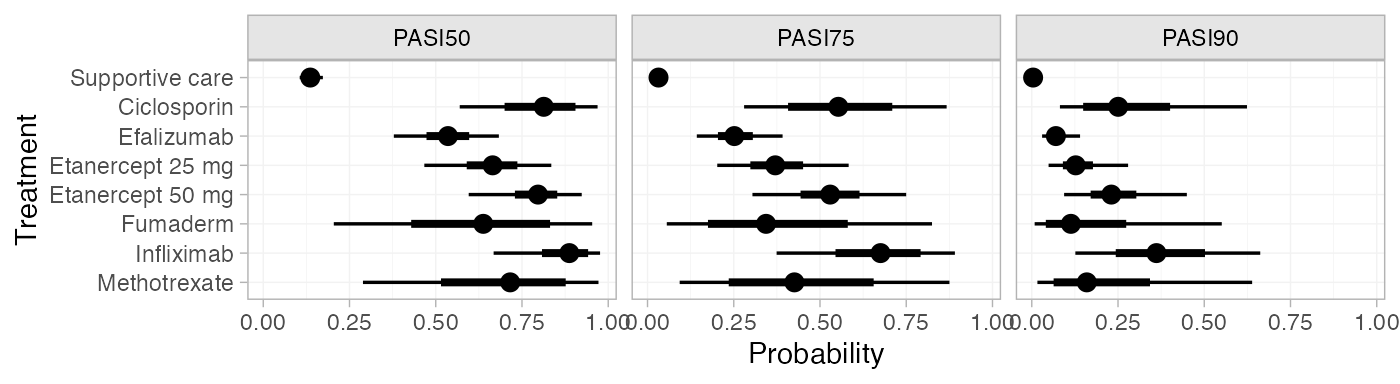 (Notice that these results are equivalent to those calculated above
using the Normal distribution for the baseline probit probability, since
these event counts correspond to the same probit probability.)
(Notice that these results are equivalent to those calculated above
using the Normal distribution for the baseline probit probability, since
these event counts correspond to the same probit probability.)
We can modify the plots using standard ggplot2
functions. For example, to plot the cutpoints together with a colour
coding (instead of split into facets):
library(ggplot2)
plot(pred_RE, position = position_dodge(width = 0.75)) +
  facet_null() +
  aes(colour = Category) +
  scale_colour_brewer(palette = "Blues")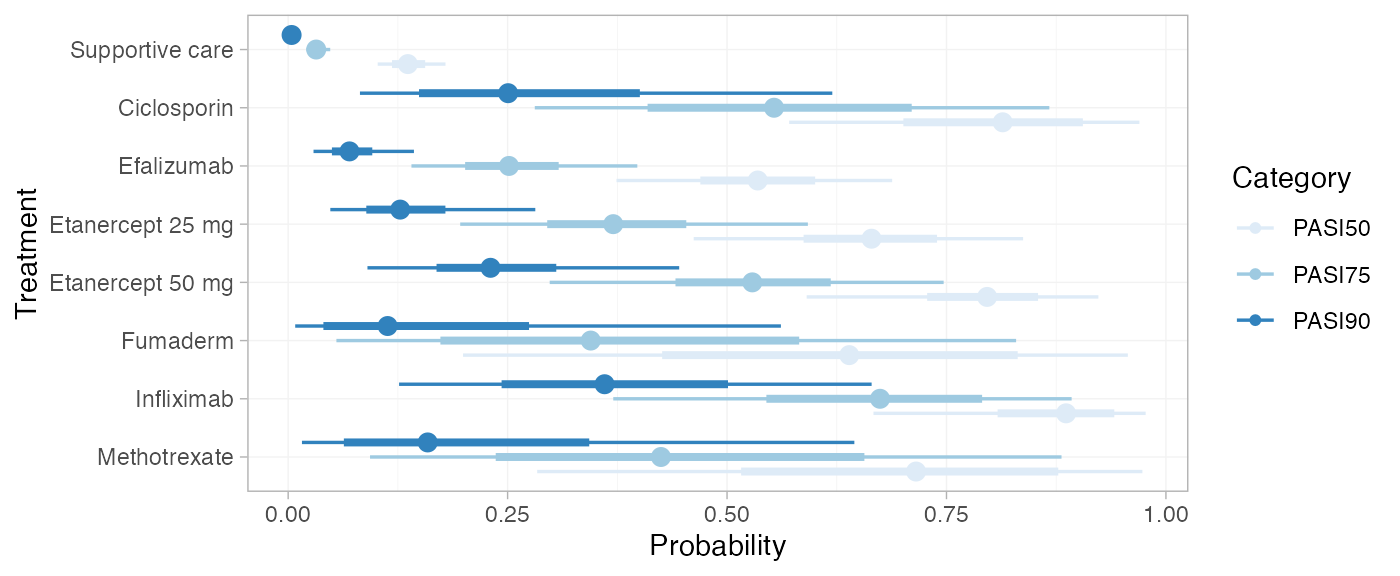
If the baseline argument is omitted, predicted
probabilities will be produced for every study in the network based on
their estimated baseline probit probability \mu_j.
Ranks and rank probabilities
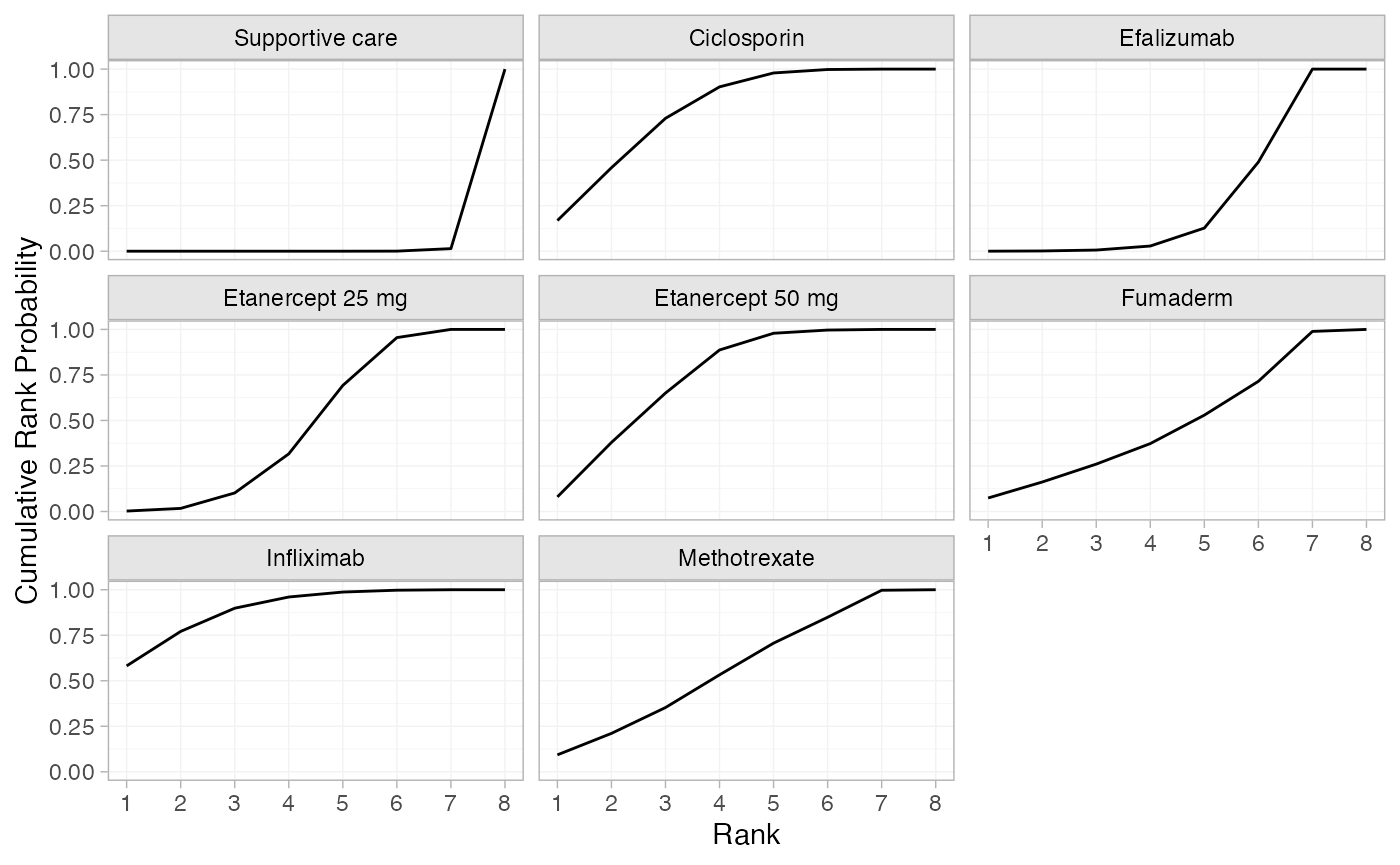
Treatment rankings, rank probabilities, and cumulative rank
probabilities can also be produced. We set
lower_better = FALSE since higher outcome categories are
better (the outcomes are positive).
(pso_ranks <- posterior_ranks(pso_fit_RE, lower_better = FALSE))
#>                        mean   sd 2.5% 25% 50% 75% 97.5% Bulk_ESS Tail_ESS Rhat
#> rank[Supportive care]  7.99 0.11    8   8   8   8     8     5481       NA    1
#> rank[Ciclosporin]      2.76 1.27    1   2   3   4     5     6287     6437    1
#> rank[Efalizumab]       6.36 0.80    4   6   7   7     7     5804     5505    1
#> rank[Etanercept 25 mg] 4.92 1.08    3   4   5   6     7     6722     5612    1
#> rank[Etanercept 50 mg] 3.05 1.19    1   2   3   4     5     5287     5935    1
#> rank[Fumaderm]         4.89 1.93    1   3   5   7     7     7565     5156    1
#> rank[Infliximab]       1.79 1.19    1   1   1   2     5     3081     3872    1
#> rank[Methotrexate]     4.24 1.88    1   3   4   6     7     5641     5889    1
plot(pso_ranks)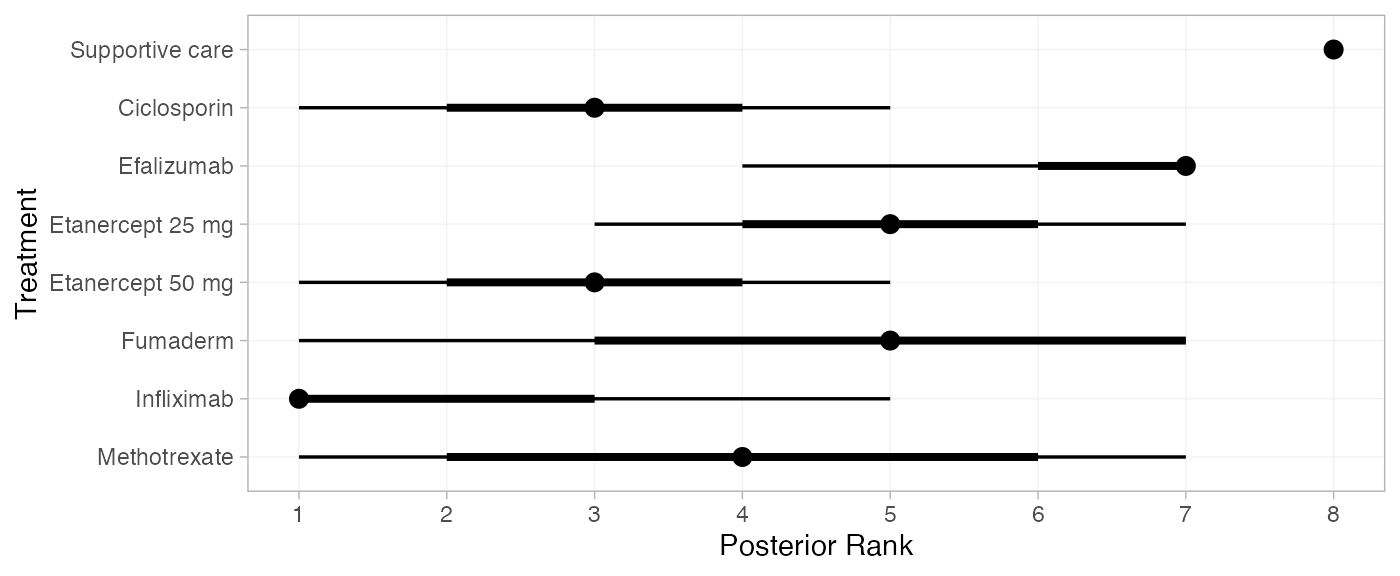
(pso_rankprobs <- posterior_rank_probs(pso_fit_RE, lower_better = FALSE))
#>                     p_rank[1] p_rank[2] p_rank[3] p_rank[4] p_rank[5] p_rank[6] p_rank[7]
#> d[Supportive care]       0.00      0.00      0.00      0.00      0.00      0.00      0.01
#> d[Ciclosporin]           0.17      0.29      0.27      0.17      0.07      0.02      0.00
#> d[Efalizumab]            0.00      0.00      0.00      0.02      0.10      0.35      0.52
#> d[Etanercept 25 mg]      0.00      0.01      0.08      0.21      0.38      0.26      0.04
#> d[Etanercept 50 mg]      0.07      0.30      0.27      0.25      0.09      0.02      0.01
#> d[Fumaderm]              0.07      0.08      0.10      0.11      0.17      0.19      0.27
#> d[Infliximab]            0.59      0.18      0.13      0.06      0.03      0.01      0.00
#> d[Methotrexate]          0.09      0.13      0.14      0.18      0.16      0.15      0.15
#>                     p_rank[8]
#> d[Supportive care]       0.99
#> d[Ciclosporin]           0.00
#> d[Efalizumab]            0.00
#> d[Etanercept 25 mg]      0.00
#> d[Etanercept 50 mg]      0.00
#> d[Fumaderm]              0.01
#> d[Infliximab]            0.00
#> d[Methotrexate]          0.00
plot(pso_rankprobs)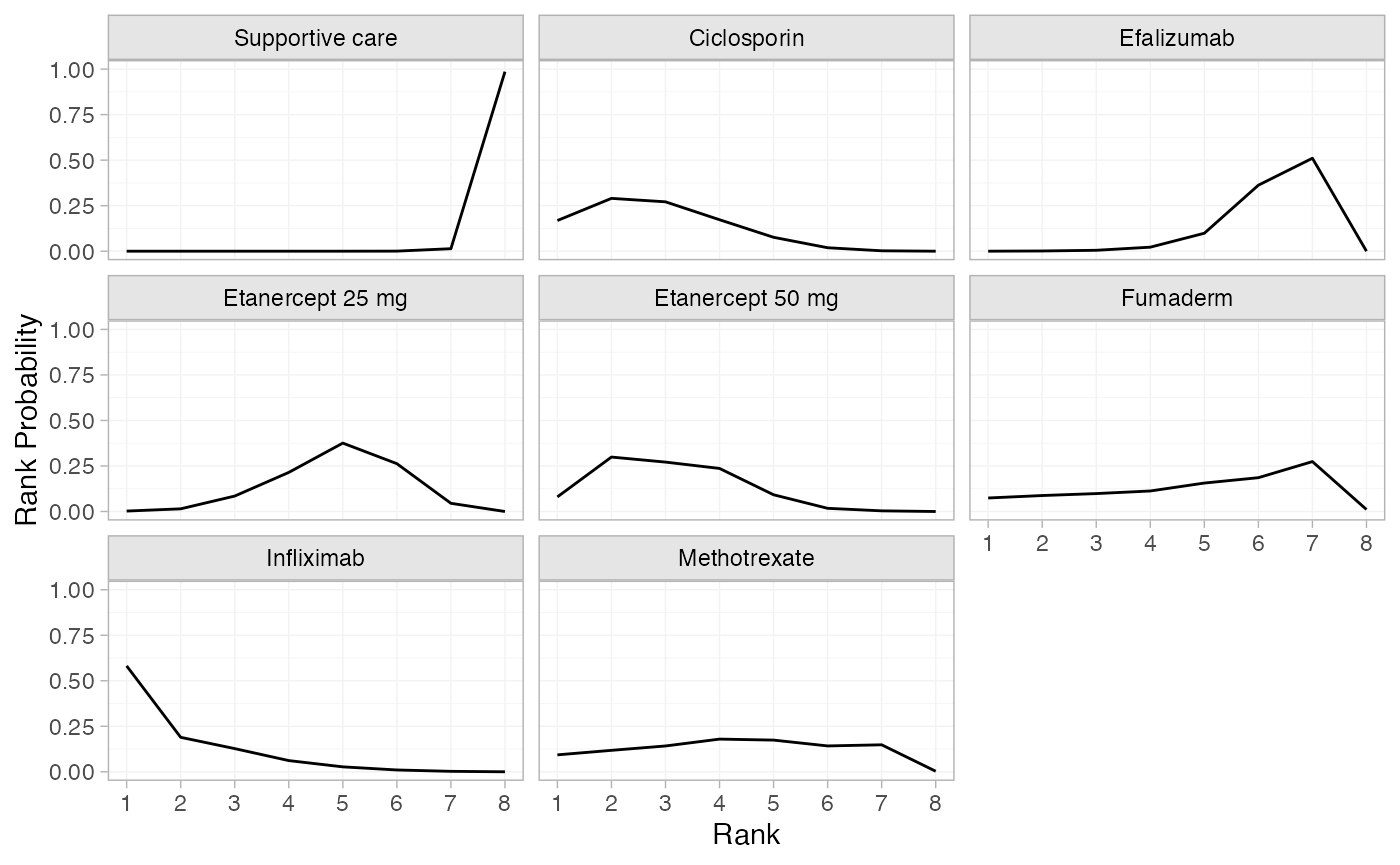
(pso_cumrankprobs <- posterior_rank_probs(pso_fit_RE, lower_better = FALSE, cumulative = TRUE))
#>                     p_rank[1] p_rank[2] p_rank[3] p_rank[4] p_rank[5] p_rank[6] p_rank[7]
#> d[Supportive care]       0.00      0.00      0.00      0.00      0.00      0.00      0.01
#> d[Ciclosporin]           0.17      0.46      0.73      0.90      0.98      1.00      1.00
#> d[Efalizumab]            0.00      0.00      0.01      0.03      0.13      0.48      1.00
#> d[Etanercept 25 mg]      0.00      0.02      0.10      0.31      0.69      0.96      1.00
#> d[Etanercept 50 mg]      0.07      0.37      0.65      0.89      0.98      0.99      1.00
#> d[Fumaderm]              0.07      0.16      0.26      0.37      0.54      0.73      0.99
#> d[Infliximab]            0.59      0.77      0.90      0.96      0.99      1.00      1.00
#> d[Methotrexate]          0.09      0.22      0.36      0.54      0.70      0.85      1.00
#>                     p_rank[8]
#> d[Supportive care]          1
#> d[Ciclosporin]              1
#> d[Efalizumab]               1
#> d[Etanercept 25 mg]         1
#> d[Etanercept 50 mg]         1
#> d[Fumaderm]                 1
#> d[Infliximab]               1
#> d[Methotrexate]             1
plot(pso_cumrankprobs)